Determination of Acidity in Foods
In terms of food quality control, fermentation management, sensory balance, and regulatory compliance, determination of acidity in foods (titratable acidity / total acidity) is one of the analyses applied to liquid, semi-solid, and fermented products. Expressing the total amount of organic and inorganic acids present in the food, this parameter is reported in terms of the predominant acid characteristic of the product, such as citric acid in fruit juices, lactic acid in milk and yogurt, acetic acid in vinegar, and tartaric or malic acid in wine and certain fruits.
Within the scope of the Turkish Food Codex relevant product communiqués and international standards (AOAC, ISO, EN); minimum or maximum acidity criteria must be met in many food and beverage groups. Our laboratory supports your quality processes by reliably detecting the total acidity in your products using national/international reference methods.
Why is Determination of Acidity in Foods Important?
Measuring the acidity value at every stage, from production lines to final product control, provides many advantages to your brand and quality system:
- Regulatory and Communiqué Compliance: It scientifically proves compliance with acidity standards determined by communiqués in products such as fruit juice, vinegar, dairy products, tomato paste, and fermented beverages.
- Fermentation and Maturation Tracking: It verifies that acid development proceeds at the targeted rate and point during yogurt, kefir, cheese, pickle, vinegar, and dough fermentation processes.
- Sensory Quality and Taste Balance: It ensures that the sourness, freshness, and overall flavor profile of the product remain at a standard quality on a batch-by-batch basis; especially in fruit-based products, it helps maintain the taste-sugar-acid balance.
- Microbiological Stability and Shelf Life: When evaluated together with low acidity and appropriate pH, it supports product durability by limiting the growth of spoilage-causing microorganisms.
- Raw Material and Fruit Maturity Control: It provides critical data in evaluating the compliance of supplied raw materials and fruits with quality specifications and their maturity level.
Method for Determination of Acidity in Foods
Depending on the color, clarity, matrix structure, and relevant standard of the product, titrimetric acidity determination is applied in our laboratory:
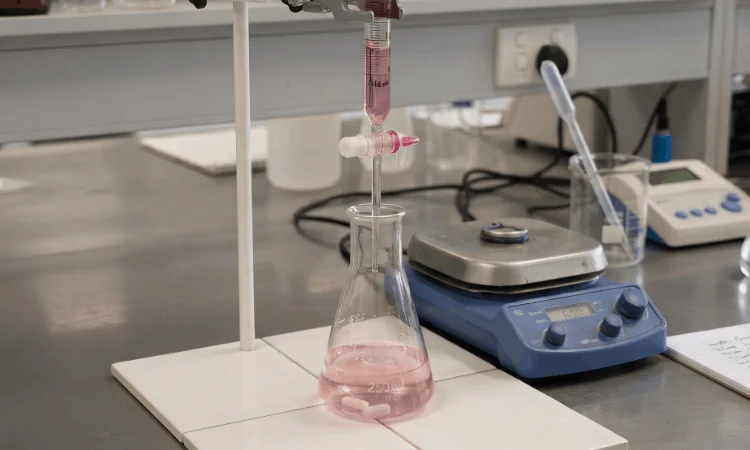
1. Indicator Titrimetric Method: In this method, commonly used in clear or lightly colored liquids and extracts, a certain amount of sample (diluted with pure water if necessary) is titrated with a standard base solution (usually in the presence of phenolphthalein or an appropriate indicator 0,1 N0,1\text{ N}0,1 N NaOH\text{NaOH}NaOH) is titrated to the endpoint. Using the volume of base consumed, the result is calculated in terms of the specific acid of the product (for example as citric acid, lactic acid or acetic acid as % or g\/L\text{g\/L}g\/L) is calculated.
2. Potentiometric Titration Method: It is a highly reproducible titration method performed up to a specified endpoint pH value (e.g., pH 8.1 or pH 8.2) with the help of a pH meter / automatic titrator in order to eliminate the difficulty of visually distinguishing the color change in dark-colored, opaque, highly pigmented, or slurry-consistency products (e.g., red fruit juices, tomato paste, dark vinegar, wine, or milk/yogurt matrices).
Which Product Groups are Subject to Acidity Analysis?
We serve a very wide range of foods and beverages with our advanced analysis infrastructure:
- Fruit juices, nectars, fruit beverages, and concentrates
- Types of vinegar (grape vinegar, apple cider vinegar, balsamic, etc.)
- Milk, yogurt, buttermilk, kefir, and fermented dairy products
- Tomato paste, ketchup, sauces, and canned foods
- Pickles, olives, and fermented vegetable products
- Wine and other fermented beverages
- Jam, marmalade, and bakery filling/sauce products
What is the main difference between acidity determination and pH determination?
Acidity determination (titratable acidity) measures the total amount of acids in food (including undissolved molecules); whereas pH determination indicates the active concentration of free hydrogen ions present in the medium. When evaluated together, both the flavor/fermentation profile and the microbiological safety status of the product are understood more clearly.
You can contact our expert team to verify your products' quality standards, fermentation control, and regulatory compliance with scientific data, and to receive a detailed quote regarding our determination of acidity in foods service.