Determination of Foreign Matter in Foods
In terms of food safety, consumer health, and brand reputation, determination of foreign matter in foods is an indispensable physical and microscopic analysis process both in raw material acceptance and final product quality control. Foreign matter refers to any organic and inorganic residue (insect fragments, rodent hair, stone, sand, glass, metal shards, plastic particles, plant stems, etc.) that is not part of the natural composition of the food and can contaminate the product during harvesting, storage, transportation, or production stages.
Within the scope of the Turkish Food Codex and international food safety standards (BRCGS, IFS, FSSC 22000), it is mandatory to audit foreign matter contamination risks using scientific methods to verify the suitability of foods for human consumption. Our laboratory ensures complete assurance for your production processes by detecting foreign matters in your products with high sensitivity using advanced stereomicroscopic imaging systems and international reference analysis methods.
Why is the Determination of Foreign Matter in Foods Important?
Regularly performing foreign matter analyses in production lines and the supply chain provides vital advantages to your business:
- Protection of Consumer Health: Prevents physical elements (glass, metal, hard plastic, stone) carrying cutting, piercing, or choking risks from reaching the consumer.
- Auditing Hygiene and Sanitation Effectiveness: Detection of biological foreign matter such as insect residues, mites, or rodent hairs directly measures the success of pest control and facility hygiene programs.
- Prevention of Product Recalls and Loss of Reputation: Prevents foreign matter complaints, legal penalties, and costly recall operations that may arise in marketed products.
- Compliance with Export and GFSI Standards: Documents the hygiene and purity criteria mandated in global food safety audits and international customer specifications with scientific reports.
Methods for Determination of Foreign Matter in Foods
Depending on the physical structure of the product to be analyzed (powder, liquid, solid, granular, or oily matrix) and the type of contaminant being investigated, internationally validated reference procedures are applied:
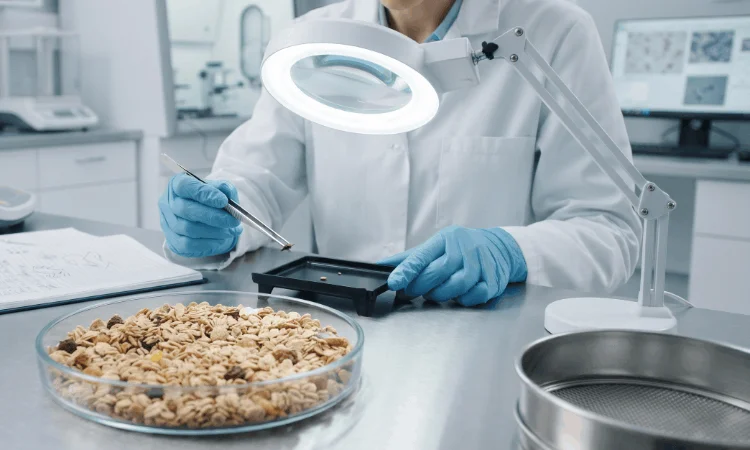
1. Filth (Light and Heavy Foreign Matter) Analysis (AOAC Methods): It is the standard reference method used to detect insect fragments, larvae, mites, and rodent hairs at microscopic levels in products such as flour, grains, spices, pulses, dried fruits, and cocoa. The organic matrix in the sample is broken down by acidic or enzymatic processes; light foreign matter brought to the surface with the aid of an oil phase (flotation technique) is filtered onto special filter papers and counted and identified under a stereomicroscope.
2. Physical Separation, Sieving, and Sedimentation Methods: Used to determine stones, soil, sand, metal particles, glass shards, plastics, and foreign plant residues in food. Heavy foreign matters are isolated through processes such as passing the sample through sieve systems, density-difference-based precipitation (sedimentation), or magnetic separation, and their quantities and sizes are reported.
3. Stereomicroscopic Examination and Characterization: Suspicious particles within the product or collected from the production line are examined under a high-magnification stereomicroscope to provide root cause analysis support for determining the source of the foreign matter (production equipment wear, packaging residue, agricultural contaminant, or warehouse pest).
Which Product Groups Are Subject to Foreign Matter Analysis?
We serve a very wide range of foods and raw materials with our advanced microscopic and physical analysis infrastructure:
- Wheat flour, semolina, starch, bread, and bakery products
- Spices, dried herbs, tea, and herbal teas
- Grains, rice, bulgur, and pulse products
- Dried fruits (raisins, figs, apricots, etc.) and nuts
- Cocoa, chocolate, confectionery, and confectionery raw materials
- Tomato paste, tomato products, canned and frozen fruits and vegetables
- Milk powder, infant formulas, and dietary supplements
To guarantee the hygiene and purity standards of your products and to receive a detailed quote regarding our determination of foreign matter in foods service, you can contact our expert team.