Determination of Water Activity in Foods
In terms of food safety, microbiological stability, and shelf-life planning, determination of water activity in foods (aw) is a quality control parameter distinct from total moisture analysis. Water activity is a measure ranging between 0.00 and 1.00 that indicates how much water present in a food is “free / available” for chemical and biological reactions as well as microorganism growth.
Even if two different food products have the same total moisture percentage, their spoilage rates can vary completely because the degree of binding of the water they contain to components such as protein, sugar, or salt is different. Our laboratory reveals the microbiological risk profile and shelf-life durability of your products with scientific data using high-precision water activity measurement systems compliant with international standards.
Why is the Determination of Water Activity in Foods Important?
Regularly measuring the awa_waw value during production processes, storage conditions, and new product development studies provides strategic advantages for your business:
- Prediction and Control of Microbiological Growth: Bacteria, yeasts, and molds require minimum water activity thresholds to multiply. For example, while many pathogenic bacteria cannot grow below aw<0,85a_w < 0,85aw<0,85, critical limits for molds and yeasts are much lower.
- Shelf Life Determination and Optimization: It ensures the scientifically determined duration during which the product will remain microbiologically safe throughout its storage period and optimizes preservative formulations.
- Preservation of Physical and Sensory Stability: It prevents physical changes such as softening (loss of crispness) in biscuits and chips, clumping in powdered foods, hardening in dried fruits, or crystallization in confections.
- Management of Chemical and Enzymatic Spoilage: The rate of lipid oxidation (rancidity), enzymatic activities, and Maillard browning reactions directly depends on the awa_waw value.
- Compliance with HACCP and Food Safety Standards: It provides official evidence for the validation of critical control points (CCPs) within the scope of BRCGS, IFS, FSSC 22000, and the Turkish Food Codex.
Methods for Determination of Water Activity in Foods
Reference measurement technologies compliant with the product matrix (solid, semi-solid, liquid, high-fat, or containing volatile components foods) and international standards (ISO 18787, AOAC 978.18) are used in our laboratory:
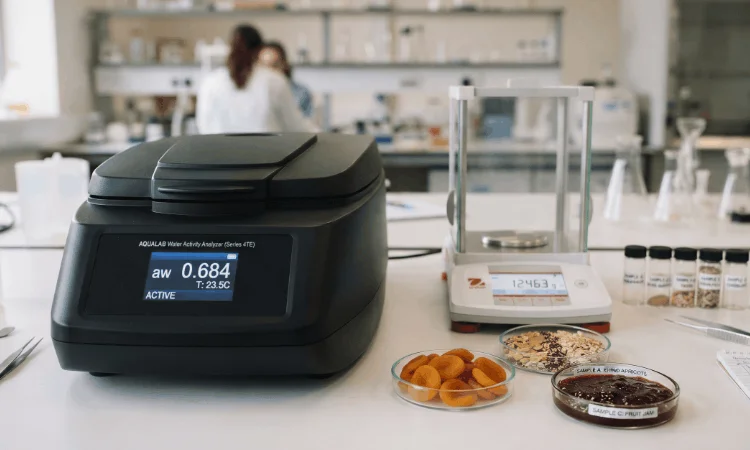
1. Chilled Mirror Dew Point Method: It is the primary reference method offering the highest accuracy and speed in food analyses. The temperature at which water vapor in the air phase, equilibrated with the sample in a closed measurement chamber, condenses on a cooled mirror surface is precisely detected by an optical sensor, and the awa_waw value is calculated directly.
2. Capacitive / Resistive Sensor Hygrometer Method: It is a measurement technique with high repeatability, preferred especially for foods containing alcohol, propylene glycol, or high levels of volatile aroma components (spices, sauces, fermented products, flavored confections) to prevent volatile substances from affecting the measurement.
Which Product Groups Are Subject to Water Activity Analysis?
We provide services across a very wide range of foods, beverages, and feeds with our advanced laboratory infrastructure:
- Bakery products, cakes, biscuits, crackers, and breakfast cereals
- Dried fruits and vegetables, nuts, and spices
- Chocolate, confectionery, Turkish delight, halva, and confectionery products
- Sujuk, salami, pastrami, and dried/fermented meat products
- Cheese varieties, milk powder, and low-moisture dairy products
- Honey, molasses, jam, marmalade and nut/paste spreads
- Sauces, ketchup, mayonnaise, ready meals, and pet foods
What is the main difference between water activity and moisture determination?
Moisture determination gives the percentage by weight of total water present in the food; however, it does not show how much of this water is chemically bound and how much is available for microorganisms. Water activity, on the other hand, measures the energy status of the free water in the food, directly explaining the spoilage potential and shelf life of the product.
You can contact our expert team to verify the microbiological safety and shelf-life performance of your products with scientific data and to receive a detailed quote regarding our determination of water activity in foods service.