Determination of Free Fatty Acids in Vegetable Oils
Food quality control processes and the oil industry's most fundamental, most critical analysis is the determination of free fatty acids in vegetable oils procedure. Free fatty acid (FFA – Free Fatty Acids) expresses the amount of fatty acid released as a result of the hydrolysis (breakdown) of triglycerides in the oil. This value is the most important quality parameter indicating the oil's hydrolytic degradation level, freshness, and the suitability of processing/storage conditions.
Under the Turkish Food Codex Vegetable Oil Regulation and international standards (Codex Alimentarius, IOOC, AOCS), limit values for free fatty acids have been set for the commercial classification of crude and refined oils, as well as for food safety and shelf‑life suitability. Our laboratory provides reliable data for your quality processes by determining the FFA level in vegetable oils with high‑precision titrimetric analysis and an expert team, in accordance with international reference methods.
Why Is Free Fatty Acid Important?
Measuring the FFA content in vegetable oils with scientific methods plays a critical role in many aspects:
- Determination of Oil Quality and Freshness: A high free fatty acid value indicates that the oil has been stored incorrectly or for a long time, exposed to high temperatures, that the seed deteriorated before harvest/processing, or that microbial activity has started in the oil. Fresh and high‑quality oils have a low FFA level.
- Control of the Refining Process: In the refining stage of crude oil (neutralization/deacidification), knowing the initial free fatty acid value is mandatory to calculate the amount of caustic to be removed and to monitor the process efficiency.
- Oxidation and Rancidity Potential: High free fatty acids reduce the oil's oxidative stability, accelerating “rancidity” reactions over time and leading to taste and odor defects.
- Commercial Classification and Regulatory Compliance: Especially for high‑value oils such as pressed olive oils, classification (“Extra Pressed”, “Pressed”, “Riviera”) is done directly according to the free fatty acid criterion (expressed as oleic acid). The accuracy of label statements is verified by analysis.
Method for Determining Free Fatty Acids in Vegetable Oils
Determination of free fatty acids in vegetable oils is usually performed with a titrimetric method calculated from the predominant fatty acid of the oil, such as oleic acid (for olive oil, etc.) or palmitic acid (for palm oil, etc.):
Alkalimetric Titration Method (TS EN ISO 660)
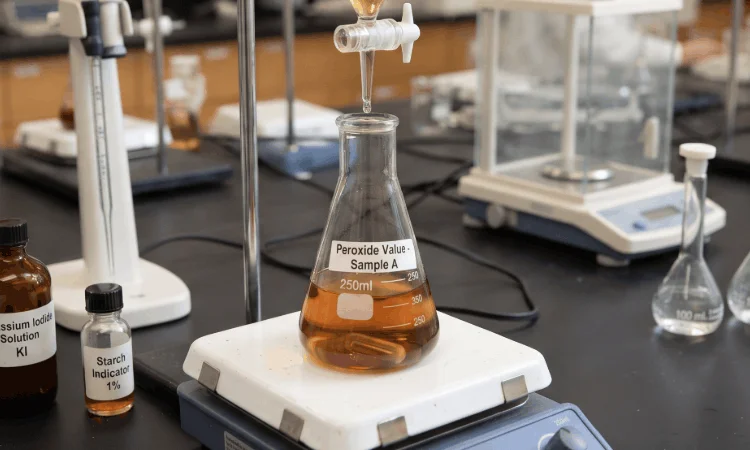
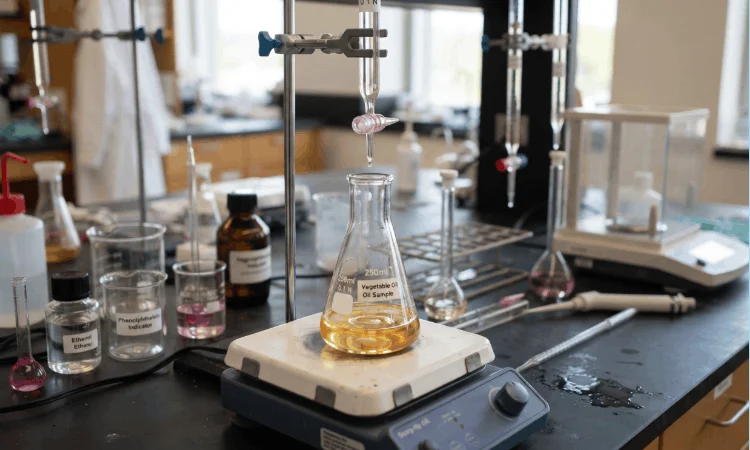
The homogenized oil sample is dissolved in an appropriate solvent mixture (usually ethanol/diethyl ether). An indicator (phenolphthalein) is added and the solution is titrated with standard sodium hydroxide (NaOHNaOHNaOH) or potassium hydroxide (KOHKOHKOH) solution. At the endpoint (color change), the amount of alkali consumed is used to neutralize the free fatty acids in the sample and calculate total acidity.
Results are usually expressed in two ways:
- Acidity Degree: The amount in milligrams of KOHKOHKOH required to neutralize 100 g of oil.
- Percentage Free Fatty Acid (% FFA): The calculated percentage of the oil's predominant fatty acid (e.g., oleic acid in olive oil).
Which Oil Groups Are Subject to Free Fatty Acid Analysis?
With our advanced laboratory infrastructure we serve a very wide range of vegetable oils:
- Olive Oils: Natural Pressed, Natural First, Refined and Riviera olive oils
- Seed Oils: Sunflower oil, corn germ oil, canola oil, soybean oil, cotton oil
- Tropical Oils: Palm oil, palm kernel oil, coconut oil
- Special Oils: Hazelnut oil, grape seed oil, sesame oil, flaxseed oil
- Crude and Refined Oils: Oil samples from all processing stages of oil production facilities
You can contact our expert team to document your products' quality standards, freshness and legal compliance and to receive a detailed quote for our determination of free fatty acids in vegetable oils service.