pH Determination in Foods
In terms of food safety, microbiological stability, thermal process design, and sensory quality, pH determination in foods is one of the key physicochemical parameters used both in production line controls and accredited laboratory analyses. Defined as the negative logarithm of the hydrogen ion concentration (on a scale from 0 to 14), the pH value determines the acidic, neutral, or basic character of a product, directly shaping its spoilage mechanisms and shelf-life behavior.
Within the scope of Turkish Food Codex product communiqués and international food safety systems (HACCP, BRCGS, IFS, FSSC 22000), pH limits must be verified by scientific methods, especially in canned goods, sauces, dairy products, meat products, and fermented foods. Our laboratory analyzes the pH value of your products in compliance with international standards using high-precision potentiometric measurement systems and matrix-specific electrode technologies.
Why is pH Determination in Foods Important?
Regularly measuring the pH value during production processes and throughout the supply chain provides vital advantages for your business:
- Microbiological Safety and Pathogen Control: The critical threshold that inhibits the growth of dangerous pathogens in foods (especially spore-forming bacteria such as Clostridium botulinum) is generally pH 4.6. Verifying this limit forms the cornerstone of product safety.
- Determination of Thermal Processing (Pasteurization / Sterilization) Norms: Low-acid foods (pH > 4.6) and acidified/acid foods (pH ≤ 4.6) are subjected to different thermal processing temperatures and durations. Accurate pH measurement ensures safety while preventing nutritional and color losses caused by unnecessary over-processing.
- Monitoring Fermentation and Ripening Processes: It controls whether the development of acidity in the production of yogurt, cheese, sucuk, pickles, vinegar, and fermented beverages is completed at the targeted rate and point.
- Technological Quality in Meat and Dairy Products: The post-mortem drop in pH in red meat and poultry is a direct determinant of water-holding capacity, color, tenderness, and shelf life.
- Preservative Efficacy and Flavor Balance: Preservatives such as sorbic acid and benzoic acid exhibit antimicrobial effects only within specific low pH ranges; furthermore, pH balances the acidity and taste profile of the product.
Method for pH Determination in Foods
Procedures suitable for the physical form of the product (liquid, semi-solid, viscous, oily, or solid matrix) and international reference standards (AOAC, ISO 2917, ISO 11289, etc.) are applied in our laboratory:
Potentiometric (pH Meter and Special Electrode) Method
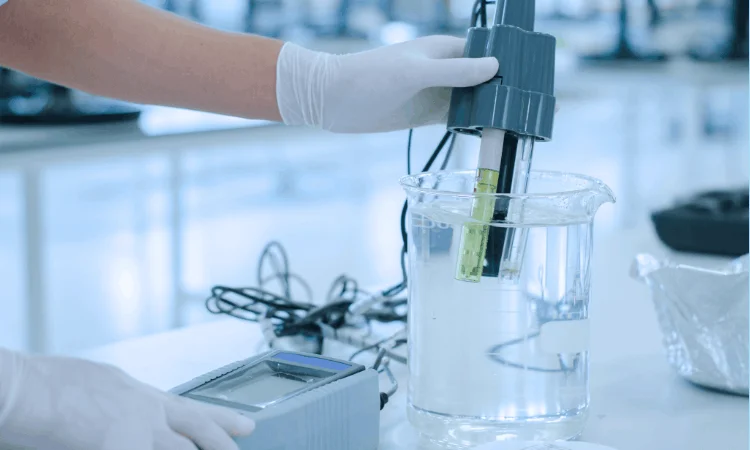
It is the most reliable and internationally validated primary method in food analysis. Potential difference measurements are performed using high-precision pH meters calibrated with certified buffer solutions (pH 4.00 – 7.00 – 10.00) and glass electrodes specifically selected for the sample matrix:
-
Liquid and Homogeneous Foods: Measurements are made by direct immersion in fruit juices, milk, vinegar, beverages, and sauces.
-
Solid and Semi-Solid Foods: Direct measurement with penetration electrodes or potentiometric determination after dilution/homogenization at standard ratios is applied to meat, cheese, dough, jam, and canned products.
-
Temperature Compensation (ATC): Because the pH value changes with temperature, all measurements are corrected with automatic temperature compensation and recorded relative to a standard reference temperature (20 ∘C20\,^\circ\text{C}20∘C or 25 ∘C25\,^\circ\text{C}25∘C).
Which Product Groups Undergo pH Analysis?
We provide services across all food and beverage categories with our advanced laboratory infrastructure and diverse matrix electrodes:
- Canned fruits and vegetables, tomato paste, ketchup, mayonnaise, and ready-made sauces
- Milk, yogurt, ayran, various cheeses, and fermented dairy products
- Red meat, poultry, sucuk, salami, and processed meat products
- Pickles, olives, vinegar, and fermented food products
- Fruit juices, nectars, carbonated beverages, and flavored waters
- Jam, marmalade, honey, molasses, and confectionery fillings
- Flour, dough, bread, ready-to-eat meals, and foods for special dietary uses
Frequently Asked Questions
What is the difference between pH determination and titratable acidity (total acidity)?
pH determination measures the active concentration of free (ionized) hydrogen ions in food and directly determines the microbiological safety of the product. Titratable acidity, on the other hand, refers to the total amount of weak organic acids (citric, lactic, acetic acid, etc.) present in the food. Both parameters complement each other in quality control and product standardization.
Why is pH measurement important in meat and meat products?
Because the pH value in red meat and poultry directly determines the product's water-holding capacity, cooking loss, color (detection of PSE and DFD meat defects), and microbial spoilage rate throughout its shelf life, it serves as a quality criterion both during raw material acceptance and in the final product.
You can contact our expert team to verify your products' food safety criteria and quality standards with scientific data and to get a detailed quote regarding our pH determination in foods service.