Determination of Ash Content in Foods
In terms of food quality control, raw material purity, and nutrient content calculations, determination of ash content in foods ranks among the fundamental gravimetric analyses. Ash refers to the inorganic (mineral) residue remaining after the organic matter is removed as a result of the controlled ignition of a food sample at high temperatures, and it serves as the first and most fundamental indicator of the product's total mineral load.
Additionally, while calculating carbohydrates in foods, the ash ratio is one of the key components used in the difference method. With an infrastructure complying with national and international standards, our laboratory determines the total ash (and, upon request, acid-insoluble ash) amount in food matrices with high precision, providing reliable data for your production processes.
Why is the Determination of Ash in Foods Important?
Determining the ash ratio in production lines and supply chains using scientific methods offers critical advantages in terms of both quality standards and regulatory compliance:
- Completion of Carbohydrate and Energy Calculations: In carbohydrate calculations performed via the difference method, the amount of ash must be accurately determined along with moisture, protein, fat, and dietary fiber.
- Monitoring Mineral Content and Level of Refinement: It provides a direct reference in evaluating the degree of refining or milling, particularly in products such as flour, starch, sugar, and vegetable oils.
- Detection of Foreign Matter, Sand, and Soil Residues: In spices, grains, legumes, nuts, and fruit-vegetable-based products, inorganic contaminants related to soil or dust are revealed through acid-insoluble ash analysis.
- Raw Material and Batch-Based Quality Control: It ensures that raw materials from suppliers comply with specifications and guarantees intra-batch product consistency.
Methods for Determination of Ash Content in Foods
Depending on the sugar, fat, moisture, or mineral structure of the product to be analyzed, internationally validated reference procedures are applied:
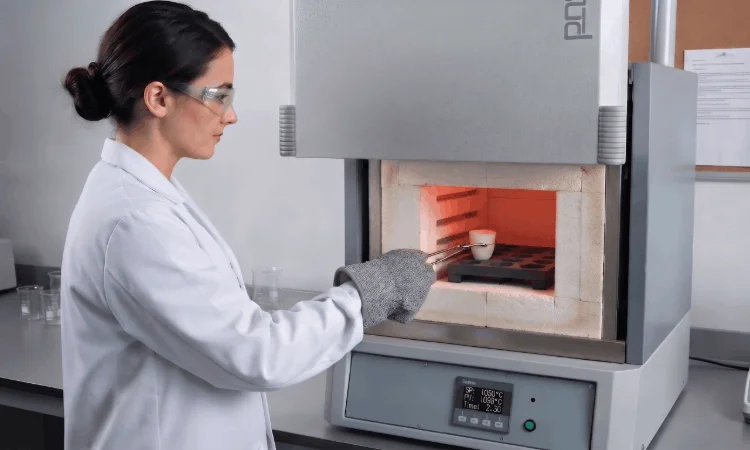
1. Dry Ashing (Muffle Furnace) Method: The dry ashing method, which is the most widely used in food analyses, is based on the principle of igniting a pre-dried sample brought to constant weight in porcelain, quartz, or platinum crucibles inside a muffle furnace (generally in the range of 525 °C – 600 °C) until organic substances are completely removed and a white or grayish-white homogeneous residue is obtained. The total ash percentage is calculated by weighing the residue, cooled in a desiccator, on an analytical balance.
2. Determination of Acid-Insoluble Ash: This is performed by treating the obtained total ash residue with a hydrochloric acid (HClHClHCl) solution, filtering, washing, and re-igniting it. It is a critical quality parameter in detecting the amount of silicate, sand, and soil contaminated in food, particularly in spices, dried vegetables, grain, and legume products.
Which Product Groups Undergo Ash Analysis?
We provide services across a very wide range of foods and feeds with our advanced laboratory infrastructure:
- Flour, semolina, bread, pasta, biscuits, and bakery products
- Spices, dried vegetables and fruits, tea, and herbal teas
- Grains, legumes, nuts, and oilseeds
- Milk, milk powder, cheese, and dairy products
- Sugar, molasses, honey, jam, and confectionery raw materials
- Sauces, tomato pastes, instant soups, and processed foods
- Animal feeds and feed raw materials
You can contact our expert team to verify your product's quality standards, complete your carbohydrate calculations, and get a detailed quote regarding our determination of ash content in foods service.