SWAB Hygiene Monitoring
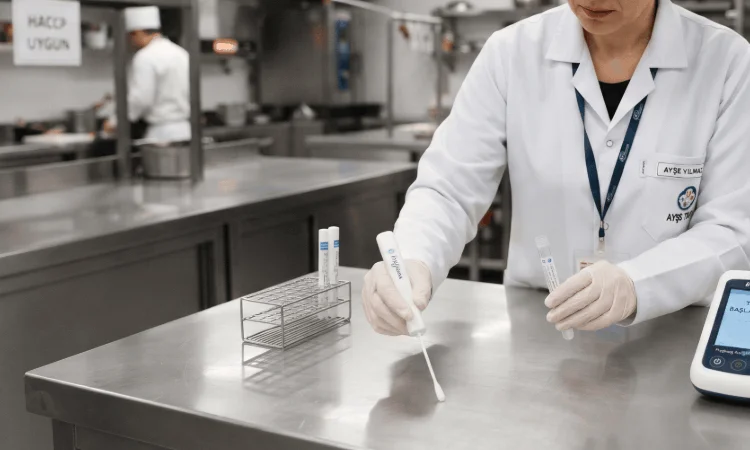
The most practical way to reveal microbial accumulations not visible on surfaces that come into direct or indirect contact with food, biofilm initiations, and insufficient sanitation points is SWAB hygiene monitoring applications. Microorganisms remaining on a visually “clean” stainless steel band, filling nozzle, cutting blade, or staff glove can shorten product shelf life and create food safety risks when transferred to the product line.
Swab analyses, a core component of environmental and surface monitoring programs in food safety systems such as HACCP, BRCGS, IFS and FSSC 22000, demonstrate whether cleaning chemicals, mechanical wiping/rinsing steps and personnel hygiene rules actually work in the field.
Which Blind Spots Does the Cleaning and Sanitation Program Reveal?
Relying solely on final product tests delays identifying the equipment or step that caused contamination. Surface swab monitoring catches the problem at its source:
- Hard‑to‑Reach Equipment Areas: Seals, band joints, filling valves, mixer shafts and slicing blades make residual microbial load on often‑overlooked surfaces visible.
- Personnel Hygiene and Glove Discipline: Measures the effectiveness of hand‑washing/disinfection habits of production, packaging and preparation staff through hand and glove residues.
- Shift Changes and Line Switches: Verifies the reset condition after cleaning on lines where different recipes, allergen‑containing products or various raw material types are processed.
- Disinfectant and Cleaning Protocol Effectiveness: Highlights any issues with chemical concentration, contact time or application method by showing numerical increases.
Which Areas and Surfaces Are Most Frequently Chosen?
- Cutting, chopping, mixing, kneading and shaping equipment
- Conveyor belts, filling heads, tank interiors and packaging machines
- Work tables, crates, shovels and hand tools
- Hands/gloves and aprons of production and packaging staff
- Floor, drain edges, cold‑room door handles and air/environment contact points
Field Application FAQs
Should the swab sample be taken immediately after cleaning or during production?
Both timings answer different questions. To assess the success of a cleaning and sanitation program, sampling after cleaning/disinfection and before production starts is recommended, while to observe accumulation and cross‑contamination risk during production, sampling mid‑production/at shift end should be performed.
Which microbiological parameter should be selected?
When evaluating overall cleaning quality, total aerobic bacterial count is the baseline; for wet lines and re‑contamination tracking, use Enterobacteriaceae or coliforms, for hand hygiene use coagulase‑positive staphylococci and E. coli, and for moist/cool or dry‑sugar areas prioritize yeast and mold analysis. Parameters can be planned singly or in combination according to your plant’s risk map.
To make hygiene control on your production lines data‑driven and to plan SWAB hygiene monitoring, you can contact our laboratory.